
Postpartum Hair Loss Singapore &
How SMP Helps New Mums
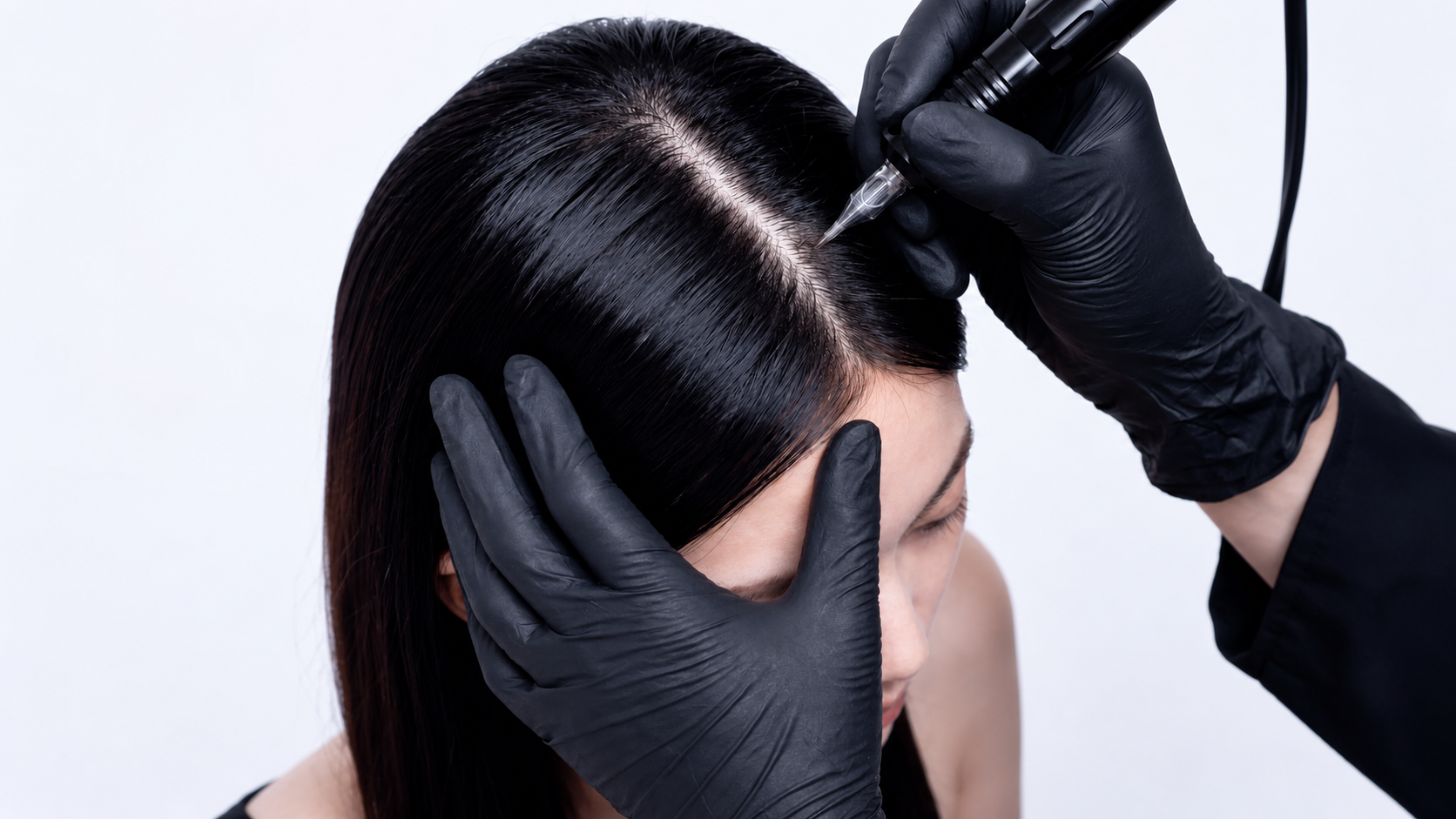
You've just been through one of the biggest physical changes of your life. Hair loss after pregnancy is real, common, and fixable. Without waiting months to see results.
If your hair is falling out after pregnancy, you're not imagining it.
During pregnancy, high oestrogen levels keep hair in its growth phase longer than usual. Your hair looks fuller, thicker, and healthier than ever. Then, a few months after giving birth, oestrogen drops sharply. All that hair that stayed on your head during pregnancy begins to shed at once.
Postpartum hair loss is one of the most common… and least talked about — parts of new motherhood in Singapore.
For most women, postpartum hair loss peaks around 3–4 months after delivery and gradually improves over 6–12 months. But that's a long time to feel self-conscious about your hair — especially during a period when you're already running on empty.
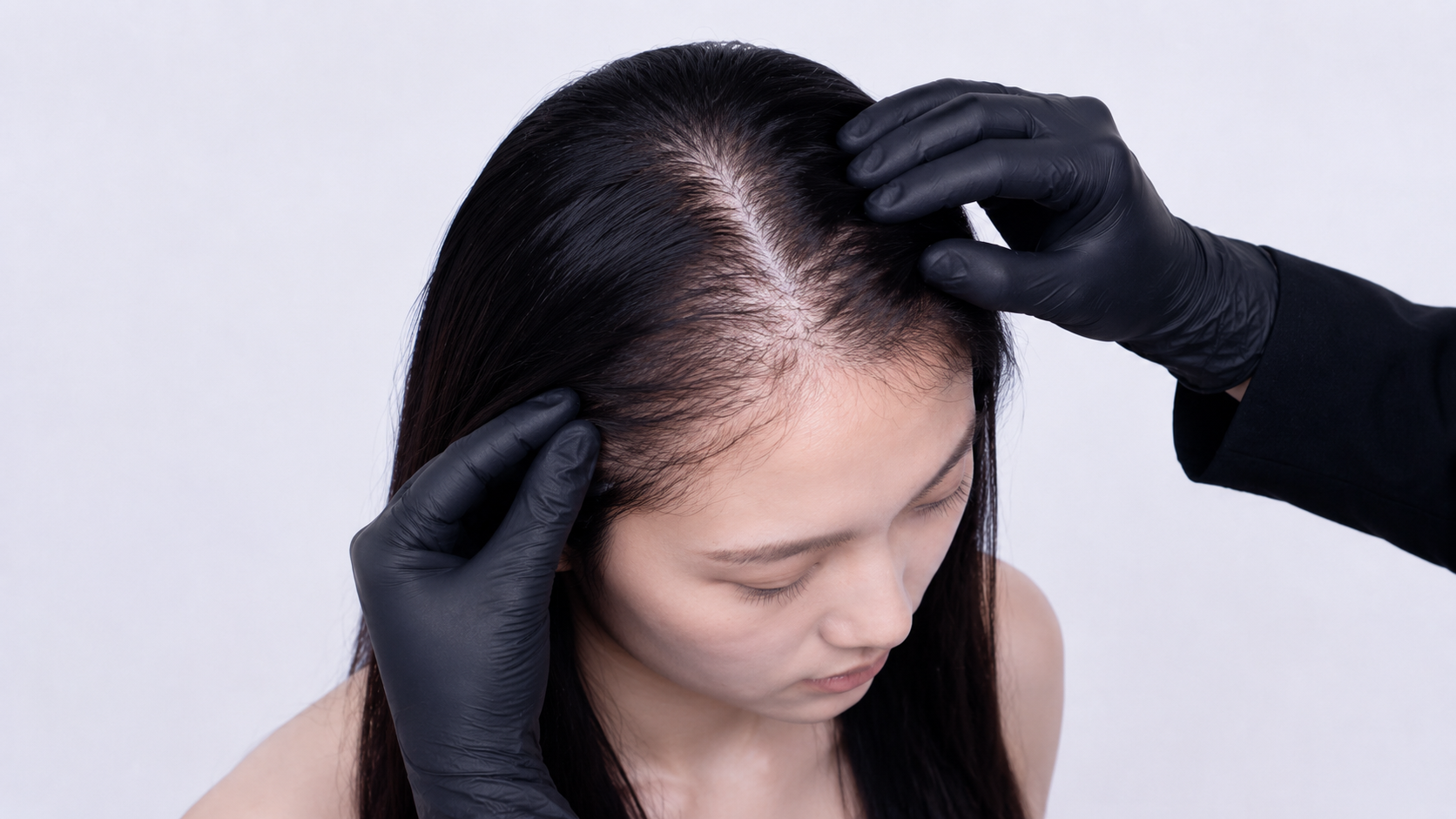
The result: sudden, noticeable thinning. A widening middle parting. A hairline that feels less defined. A ponytail that's half the thickness it used to be.
SMP doesn't regrow your hair.
It makes the loss invisible while you wait.
This is an important distinction to understand.
Scalp micropigmentation is not a hair loss treatment in the medical sense. It doesn't stimulate regrowth or address the hormonal cause.
What it does is fill in the visual gaps:
The widened parting, the exposed scalp, the thinning spots with micro-precision pigment dots that mimic the shadow and density of natural hair.
The result is immediate. You walk in with a visible parting and walk out looking like you have a full, dense head of hair.
For postpartum clients, this matters because:
It works right now.
You don't have to wait 6–12 months for your hair to recover.
It's completely safe.
No chemicals, no hormones, no invasive procedure.
It doesn't interfere with regrowth.
As your natural hair comes back, it grows through the pigment seamlessly.
It's low maintenance.
Zero downtime. You can be back home with your baby within hours.
What a postpartum SMP session looks like
01
Before your session
Book a free e-consult via WhatsApp. Send us a photo of your parting or area of concern. We'll assess whether SMP is suitable for your current hair state and estimate the number of units needed.
02
During your session
Numbing cream is applied for 20 minutes before we begin. The procedure is gentle. Most clients feel nothing more than a light scratching sensation. Sessions typically run 2-3 hours depending on the area.
03
Micro-dot layering
Using our precision technique, we deposit tiny pigment dots that mirror the natural shadow and density of your hair. Dot placement follows your scalp's curvature and natural hair direction — nothing is uniform or mechanical.
04
After your session
You'll see results immediately. 1st session gives a subtle, soft difference while 2nd session adds density giving a fuller appearance. There’s no downtime, just keep the SMP area dry for 24 hours post-appointment.
05
Session 2
(Optional but recommended)
We recommend at least 14 days between 1st and 2nd session to allow the SMP area to fully heal. A second session builds more layers, giving fuller and refined appearance.
What does postpartum SMP cost?
Postpartum hair loss in women typically affects the middle parting and hairline — not the full scalp. This makes it one of the more affordable SMP treatments.
| Treatment Area | Estimated Treatment Size | Estimated Price (SGD) |
|---|---|---|
| Left Hairline (Ladies) | 1–3 units | From $300 |
| Right Hairline (Ladies) | 1–3 units | From $300 |
| Middle Hairline (Ladies) | 1–6 units | From $300 |
| Hair Parting (Ladies) | 1–6 units | From $300 |
| Receding Hairline | 2–4 units | From $600 |
| Crown or Bald Spot | 3–6 units | From $900 |
| Full Top Scalp Coverage | 7–12 units | From $2,100 |
| Scar Camouflage (FUE/FUT) | 2–4 units | From $600 |
Estimated SMP Price Range
Flat rate: $300 per unit. No hidden fees.
Trusted reviews from our clients
SMP is non-invasive. Pigment is deposited into the most surface layer of the scalp. This does not affect hair loss or hair follicles. This is also not designed to promote hair growth.
If you’re breast-feeding, do note that numbing cream is utilised. Breast milk that is pumped within 12 hours post-SMP have to be discarded.
Is SMP safe for postpartum women?
Questions About SMP & Postpartum Hair Loss
-
We generally recommend waiting until 4–6 months postpartum. By this point, the acute shedding phase has usually stabilised, which gives us a more accurate baseline to work with. Coming in too early — when hair is still actively shedding — can affect how the result settles.
-
No. As your natural hair regrows, it grows through and around the pigment dots, blending with them naturally. The fuller your hair becomes, the more seamlessly the SMP blends in.
-
If you’re breast-feeding, do note that numbing cream is utilised. Breast milk that is pumped within 12 hours post-SMP have to be discarded.
-
Most postpartum clients treating the middle parting need 1–2 sessions. We'll give you an honest assessment during your free e-consult.
1 session creates a subtle, natural improvement in density. A second session adds more layers, giving a fuller and refined appearance.
-
If your hair fully recovers, the SMP will simply become less visible as your natural density returns — it won't clash or look out of place. Many clients whose hair recovered still prefer keeping the SMP for the added density and definition it provides.
-
Book a free e-consult and let us know. We assess each client individually. Many scalp conditions are fully compatible with SMP once they're managed — we'll advise you honestly.
Ready to stop waiting and start feeling like yourself again?
A free e-consult takes less than 5 minutes. Send us a photo of your concern and we'll give you an honest, no-pressure assessment.